Monika Griefahn

  • Home
  • Monika Griefahn
    • Dr. Monika Griefahn,
      Former Minister
    • Curriculum vitae (PDF)
    • Downloads
    • References
    • References appointments
    • Publications
    • Photos
    • Archives German Parliament
  • Volunteering
  • institute for media,
    environment, culture
    • Cradle to Cradle
  • Blog
    • Politics
    • Culture
      and
      Media
    • Opinion
    • Cradle
      to
      Cradle
    • Right
      Livelihood
      Award
  • Appointments
  • Contact
    • Site Notice/Imprint
    • Privacy Policy
  • English
    • Deutsch
You are here: Home / Right Livelihood Award / Bangladesh on its way to a „solar nation“

4 July 2014 | Blog-Team

Bangladesh on its way to a „solar nation“

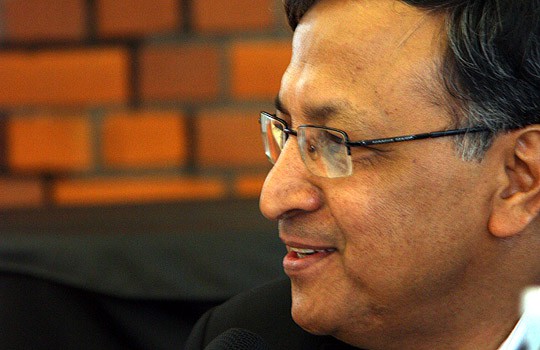
Dipal Barua
Listening to Dipal Chandra Barua might cause astonishment every time one hears him talk about his work and his vision: He wants Bangladesh to be the world’s first “solar nation”!
This might sound like daydreaming at first, but if you have a closer look at the work of Dipal Barua, laureate of the Right Livelihood Award (“Alternative Nobel Prize”), there is reason to be optimistic. At the conference “Teaching Right Livelihood” in Kassel in May, I had the privilege to meet him and could participate in a workshop in which he presented his work and afterwards discussed his actions and vision with the audience.

One notices quickly that Dipal Chandra Barua not only complains about worldwide problems and wrongdoing, but is active himself. He gets down to the root of a problem and offers long-term solutions. Dipal Chandra Barua has already visited thousands of villages in Bangladesh and has gotten an idea of the situation. Often people living in these rural areas of Bangladesh had to get along without any connection to the electricity grid (in 1996 this was so for about 85 percent of the population). That is why they spent the time after sunset in absolute darkness. Their light source mainly consisted of kerosene-fueled lamps.

After the non-profit organization Grameen Shakti was established in 1996 the situation changed quickly in those rural areas. That is due to Dipal Chandra Barua’s model for implementing sustainable light and energy – both of which provides a win-win situation: On the one hand the rural population of Bangladesh gets the chance to raise its standard of living by installing its own solar home systems (SHS), on the other hand and at the same time they support the expansion of renewable, climate-friendly energy sources. A financial mechanism helps to reduce the cost of the installation of an SHS to the monthly cost of kerosene. The model is successful: Up to now about 3 million solar home systems have been installed in rural areas of Bangladesh. It is also remarkable that Dipal Chandra Barua with his Green Technology Center (GTC) explicitly supports and encourages women to complete a technical training. He does so with great success! Many women work as “green entrepreneurs” in the growing market of renewable energies. This causes, in addition to the environmental benefits, a change in the reputation of women in the Bangladeshi society, in which the majority of the people belongs to the Muslim religious community.

Dipal Barua demonstrates how the expansion of renewable energies in developing countries can become a success: it takes a decentralized supply with renewable energy and additional value for health, education, and productivity. Now it remains to be seen whether Dipal Chandra Barua’s vision comes true a 100 percent, which would mean that 75 million people in Bangladesh benefit from the use of renewable energy.
Filed Under: Right Livelihood Award

Please share this in your community:

« Conference of those who „make the world better“
Strong women and solar energy for daily life »

Leave a Reply Cancel reply

Your email address will not be published. Required fields are marked *

Search

Please stay in touch!

  • E-mail
  • Facebook
  • LinkedIn
  • Phone
  • xing
  • YouTube

Insights

Cradle to Cradle Congress 2026


Save the date! For the tenth time, the Cradle to Cradle NGO is hosting the international Cradle to Cradle Congress on September 17 and 18, 2026. The focus is on exchange and networking—panel discussions with stakeholders from politics, business, and science, inspireing keynotes, and everything important about the transformation of society toward a true circular economy await guests. C2C Congress 2026


eFuels

Synthetic fuels are one of the decisive factors for the energy transition away from fossile fuels. That is why I am committed to the further development and practical use of eFuels and and am spokesperson for the board of the eFuel Alliance.
English website of the eFuel Alliance


Living City Foundation

The Living City Foundation sees itself as a catalyst for overcoming urban challenges and supports the exchange of experiences between cities, the federal government, the states, and society. It promotes projects and awards a foundation prize once a year. I am very pleased to be able to contribute to the Living City Foundation as deputy chair of the foundation board.
To the foundation’s website


Right Livelihood Award

They are committed to a vibrant democracy and human solidarity, addressing the most pressing issues of our time: The 2025 winners of the Right Livelihood Award are: the organization Pacific Islands Students Fighting Climate Change (PISFCC, Oceania) and Julian Aguon (Guam) / the research initiative “Justice For Myanmar” / Audrey Tang from Taiwan and the network “Emergency Response Rooms” from Sudan. Read more about the “Alternative Nobel Prize” here.


Federal Order of Merit

After the award ceremony, Olaf Lies, Monika Griefahn and Rainer Rempe stand together. Photo: Frank Ossenbrink

After the award ceremony, Olaf Lies, Monika Griefahn and Rainer Rempe stand together. Photo: Frank Ossenbrink

In 2018 Dr. Monika Griefahn received the Federal Order of Merit. Please read more about her biography and about the award ceremony in our blog.


Blog Archive

  • Home
  • Monika Griefahn
  • Volunteering
  • institute for media, environment, culture
  • Service
  • Blog
  • Contact
  • Site Notice/Imprint
  • Privacy Policy


Logo Monika Griefahn GmbH/institut medien umwelt kultur Monika Griefahn GmbH
Phone: +49 4181 4069262
Email:
Website: www.institut-muk.de
  • E-mail
  • Facebook
  • Instagram
  • LinkedIn
  • xing
  • YouTube
Copyright © 2013–2026 | Zurück zum Seitenanfang/Back to top | Alle Rechte vorbehalten! – All rights reserved.