Are dogs being humanized, while children are just a nuisance? Probably not in such sweeping terms, but since I’ve recently started spending time with my four grandchildren, I’ve noticed situations I wasn’t familiar with in the past. I’d like to describe what I’ve observed over the past few weeks in various cities and along the Baltic Sea.
Time and again, I see dogs being pushed around in strollers, and I wonder: Why aren’t they walking? Take, for example, a medium-sized mixed-breed dog sitting patiently in a stroller next to his owner, who’s sitting on a park bench. The dog clearly is not old or sick and would probably love to run around and get some exercise. It bothers me that he can’t do that, but instead is being pushed around in a stroller like a baby. After encountering similar situations in Berlin, Hanover, and Potsdam, I did some research: The market for dog strollers is booming; some cost as much as 800 euros. My observations seem to reflect a trend.
CHANGES IN SOCIETY, BUT…
We often took our dog with us, too—on vacation or when we were invited somewhere. But it never occurred to us to put him in a stroller. The fact that these days there isn’t always someone home automatically, as there was back when men were the sole breadwinners—meaning you can’t just leave the dog at home anymore—isn’t a problem. Society is changing, but why this humanization of dogs (and the restriction of their needs and natural behavior)?
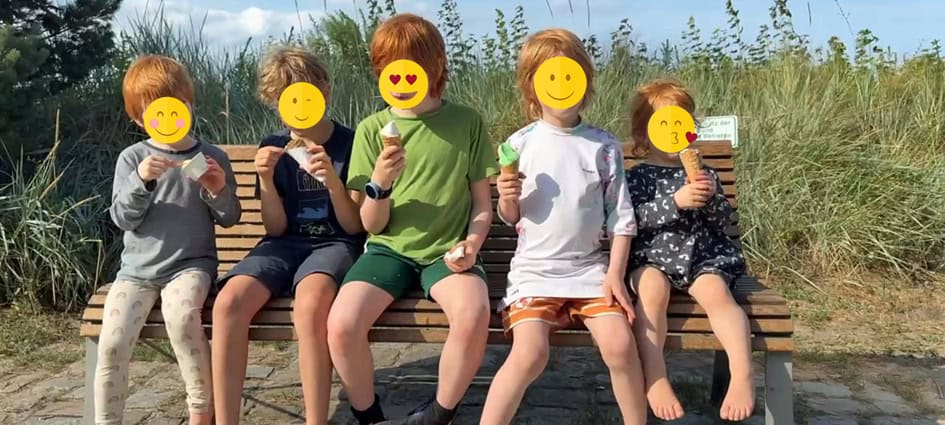
And at the same time, I notice this: Where I expect human behavior—where I remember it from the past as positive, friendly, and sociable—that’s where I miss it—namely, when it comes to children. There were four of us when we were little, and during the holidays we’d always run around on the Baltic Sea coast with lots of other kids. And today, my four grandchildren are little and run around just like kids do. Only the adults’ reactions are completely different from what they used to be. We hear the neighbors whispering; they roll their eyes in annoyance; some even tell us that the kids are getting on their nerves.
The number of dogs has increased significantly since 2015—there were 10.6 million dogs in Germany in 2025. That’s about 2.5 million more than ten years earlier. They seem to be playing an increasingly important role in society—perhaps as a result of the growing number of single-person households? A dog as a loyal companion—why not? But doesn’t it become problematic when we treat them like humans, contrary to their natural needs?
Society is becoming increasingly dog-friendly, and that’s a good thing. Dogs can be taken to restaurants, and they’re often allowed in the office—which is a positive development for the animals compared to the kennel and backyard conditions of previous decades. However, I’m a little concerned that we’re going too far.
The fact that children seem to be less and less accepted worries me just as much. Have we lost the habit of liking and tolerating children—now that there are significantly fewer children than before, and significantly more elderly people? Don’t older people still have to say: Children are the future?!
HARD ENOUGH FOR YOUNG FAMILIES
There are so many things that can deter young people from starting a family: expensive rent, unaffordable housing, rampant traffic as a constant danger, a job market that requires constant readjustment, and the general state of global crisis. If they do decide to have children despite all this, they shouldn’t, on top of that, have to deal with neighborhood disputes over noise. We should continue to be a society that welcomes children with open arms and takes joy in them. My impression is that in Germany, even compared to other countries, the tolerance threshold for normal childhood behavior is lower.
Yet we need the new generation for our shared life. To remain creative and open-minded, to experience the world anew and be fascinated by it, just like children are. And, if you will, for our social security systems as well. No matter which aspect is most important to you—children are the future. And, of course, a dog that’s allowed to remain a dog.
What are your thoughts on this? What experiences have you had with these phenomena? Feel free to comment on this post. We publish all respectful comments.
 Monika Griefahn GmbH
Leave a Reply