Robots, giant screens, useful gadgets, and things the world doesn’t need—that’s how this year’s IFA electronics trade show in Berlin presented itself. Right in the middle of it all was something truly forward-looking: the Cradle to Cradle NGO with its booth dedicated to a true circular economy.
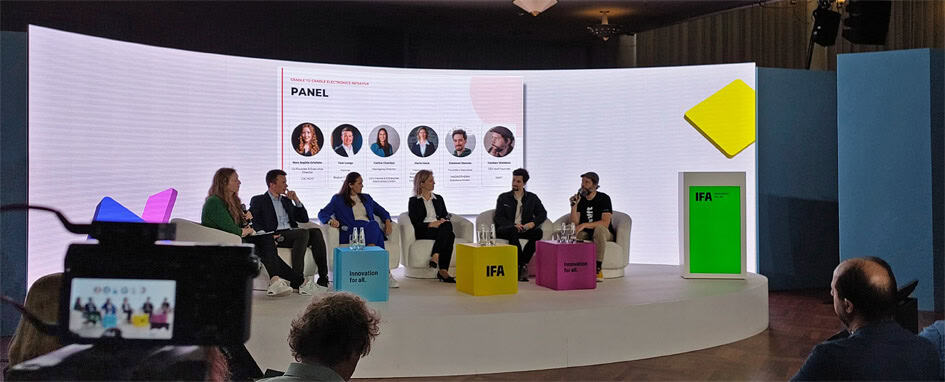
On the IFA Creator Stage: “Reimagine Electronics. Circular by Design.”
Because while strolling through the trade show, the question of just how much electricity is consumed here in a single day inevitably comes to mind, the question of how many materials are used here and are never reused remains hidden. The Cradle to Cradle NGO has gotten to the bottom of the issue of resources used and wasted.
The experts in true circular economy, in collaboration with the Boston Consulting Group, have published the study “Materials, Margins, Regulation: The Cradle to Cradle Case in Europe’s Consumer Electronics Market.” The authors quantify the extent to which commercial benefits would increase and European markets would become more resilient if the Cradle to Cradle approach were implemented. That is, if all materials used were designed and incorporated in such a way that they could circulate in loops without loss and be reused repeatedly. In the case of a washing machine, for example, the demand for primary materials could be reduced by half through a circular design.
DEPENDENCE ON IMPORTS
The study provides figures on an alarming dependence on imports—whether raw materials or components. The EU electronics industry places 12 to 13 million metric tons of material on the market annually, including approximately 1.6 million metric tons of critical raw materials as defined by the EU CRMA list. Among these materials are some for which the market is almost entirely dependent on China. It is therefore imperative to consider recycling in this context.
In any case, there is plenty of material available in the EU, as the study also shows. Europe generated around 13 million metric tons of e-waste in 2022—less than half of which was formally collected. Across the EU, household appliances and consumer electronics contain critical raw materials worth 65 billion euros. If that isn’t a reason to get serious about recycling!
A CRADLE-TO-CRADLE FREEZER
For this to work effectively, however, it’s important to align product design with this goal from the very beginning. The Cradle to Cradle NGO hosted an event on the IFA’s Creator Stage, featuring representatives on the panel from companies that are rethinking the design of their products. For example, Maria Mack from Liebherr Home Appliances described the process from the initial idea to a completely redesigned freezer. It took ten years of research and a production line built to meet new requirements before the appliance finally reached the market. Now, she said, the freezer is manufactured in such a way that it can be recycled.
Also on the panel was Emanuel Stanoiu from Magnotherm Solutions GmbH, which has developed a magnetic cooling system that could soon make harmful refrigerants a thing of the past. And as a representative of repairable smartphones, Carsten Waldeck explained how Shiftphone is rethinking mobile phones. These are just three examples of companies that are concerned about resource issues and are taking action accordingly. Given the figures from the study, these pioneers urgently need more companies to join them.
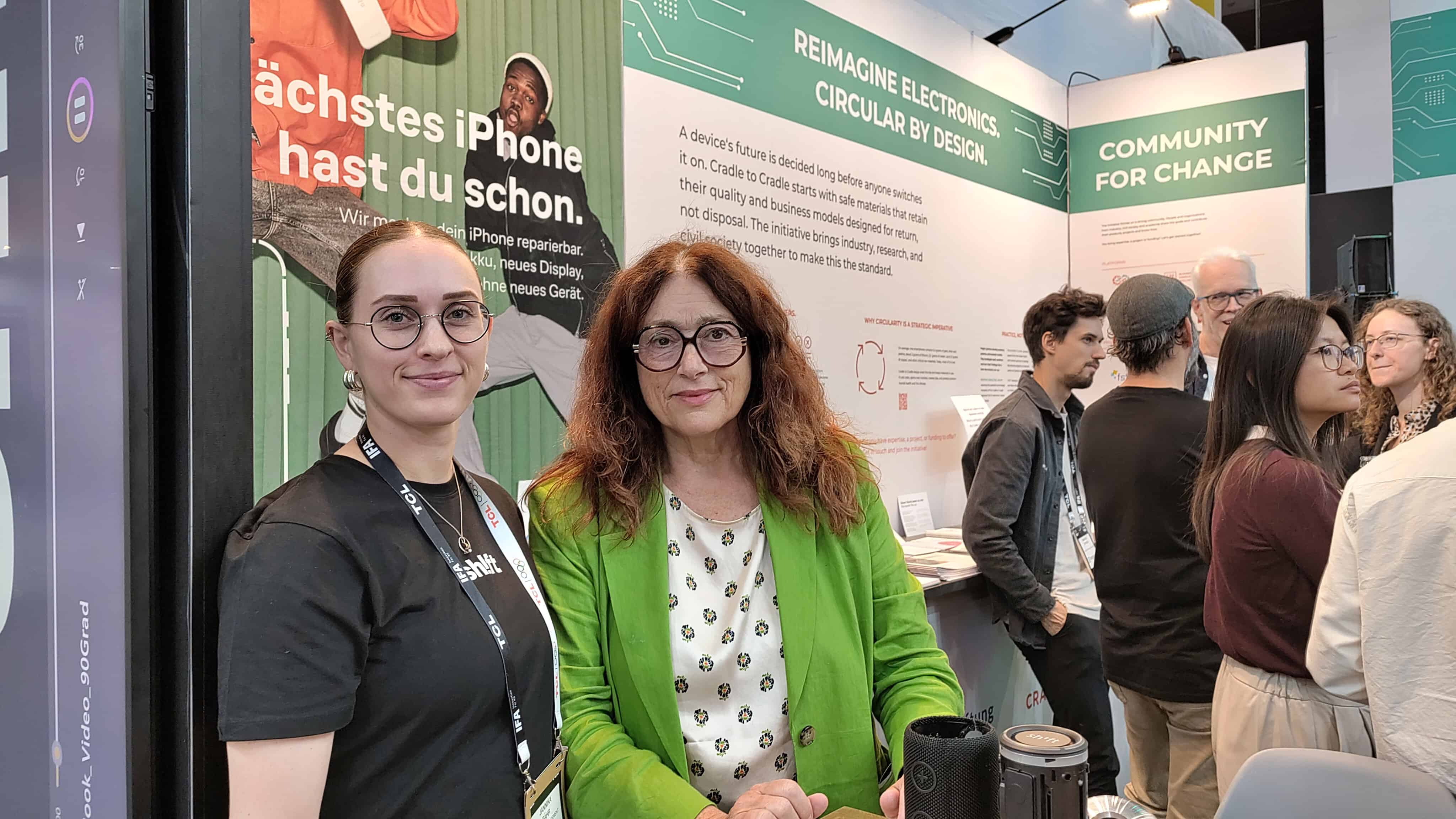
Monika Griefahn in conversation with Shiftphone, which shared a booth with the Cradle to Cradle NGO at IFA.
In fact, reducing dependencies should already be reason enough to join these three—especially in these crisis-ridden times. The Cradle to Cradle NGO wants to accelerate this process and is therefore calling for more policy decisions to set the course. This would also have the advantage of creating a level playing field for everyone. If all externalized costs—that is, damage to health and the environment—were factored into prices, the economic viability of linear production would already look very different.
EU LEGISLATION FOR A CIRCULAR ECONOMY
At least the EU is trying to implement regulations: The “Right to Repair” legislation it has passed is a well-known example of this. Even if this is unsatisfactory in that, for instance, we in Europe would then have to repair Chinese hazardous waste instead of prioritizing devices that are already designed with sustainability in mind. The Circular Economy Act is set to be introduced later this year, shifting key product requirements to the design phase. That would be a major step forward.
And it would bring us closer to my vision of an IFA where not only does 100 percent of the electricity come from renewable energy, but all the materials in every consumer good are also kept in circulation. That would be true innovation! Let’s say, in ten years? I’d be strolling through the trade show with even more enthusiasm.
About the study.
About the Liebherr freezer.
About Shiftphone.
Magnotherm’s website.
 Monika Griefahn GmbH
Leave a Reply