The tenth international Cradle to Cradle Congress has once again demonstrated that the transformation toward a true circular economy has long been underway. Over the course of two days last week, 1,000 participants, 100 volunteers, and many German and international speakers from business, politics, and civil society exchanged their concepts, activities, and ideas on the circular economy based on the Cradle to Cradle approach. As a result, the congress is becoming increasingly important as a forum that provides impetus for this transformation.
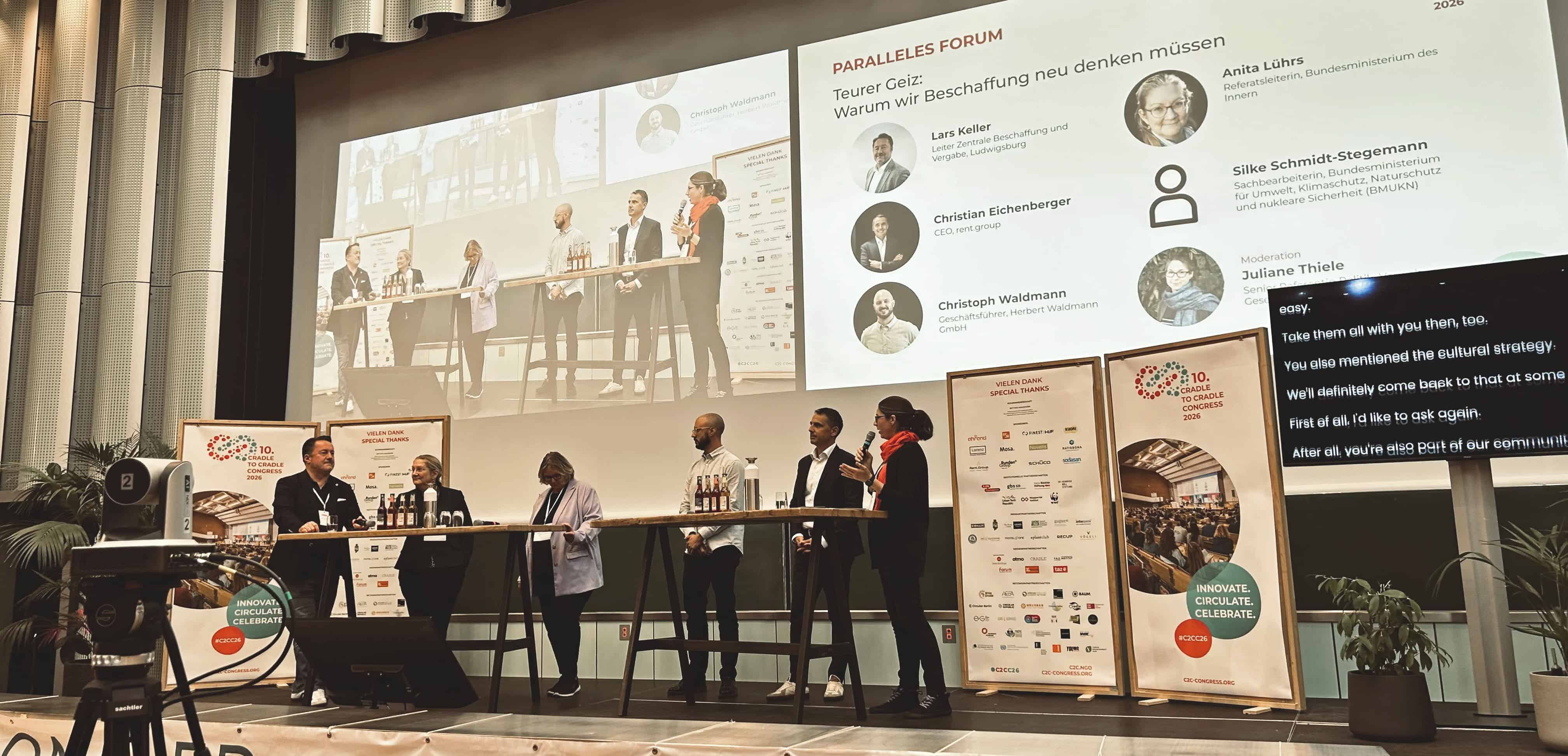
The C2C Panel on Circular Procurement.
CYCLES IN PUBLIC PROCUREMENT
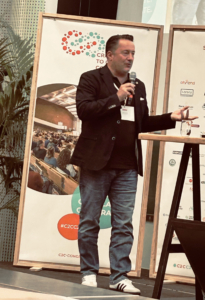
Lars Keller of the City of Ludwigsburg.
What is particularly important to me: the true circular economy in public procurement. The panel on this topic featured a very inspiring lineup—including a city representative who has integrated the Cradle to Cradle concept into his procurement office without making a big deal of it. A businessman who has developed leasing models for municipal procurement. A department head at a ministry who is advocating for uniform criteria for circular procurement at the federal and state levels. And another ministry staff member who is embedding the topic in her working groups.
The total annual volume of public procurement in Germany is estimated at up to 500 billion euros. The procurement offices in this country therefore hold the key to making a real difference through circular procurement and new business models. The resources they could save in the process would be enormous. They would reduce dependence on international supply chains and protect public health and the environment.
The legal framework allowing the public sector to consider criteria other than price has long been in place. Even when procurement regulations stipulate that the “most economically advantageous” bid is the criterion for awarding a contract, this does not mean that the lowest price wins. Often, the fear of legal disputes is the reason these opportunities are not fully exploited. One person who does not shy away from this risk is Lars Keller, who heads the Central Procurement Department for the City of Ludwigsburg.
SUPPORT FROM A CENTER OF EXPERTISE
For the past 10 years, he has been focusing on qualitative criteria such as environmental protection, health protection, and social considerations when Ludwigsburg makes purchases. He says that if you want to bring about change, you have to be willing to take the risk of requests for Reconsideration. However, since the federal government has also established a center of expertise for sustainable procurement, that risk isn’t actually that great. His message to his colleagues in other municipalities: Just do it!
Christoph Waldmann, CEO of lighting manufacturer Herbert Waldmann, learned firsthand that circular thinking is not yet consistently implemented in procurement practices. He lost out to a company using linear production methods in a Bundeswehr tender for 10,000 lamps despite submitting a circular concept, and it is his wish that commitment to the environment, health, and social issues will be better recognized by public procurement offices.
Political representatives Anita Lührs from the Federal Ministry of the Interior and Silke Schmidt-Stegemann from the Federal Ministry for the Environment welcomed the insights from the field. They are advocating for the harmonization of state procurement regulations and federal rules to eliminate uncertainties. It is also important, they noted, for the federal government to enter into more framework agreements, as has long been standard practice in IT procurement. This would allow manufacturers to better adapt to public sector purchasing.
COMPANIES TEST NEW BUSINESS MODELS
In any case, the business world has long since become more flexible and is testing new business models—as Christian Eichenberger of Rent Group explains. His company offers a rental model for office furniture. This eliminates the upfront investment costs for office chairs, desks, or lighting; instead, the municipality enters into rental agreements for a specific period. This means they have less responsibility, no disposal issues, and often end up saving money compared to purchasing the furniture outright. And Rent Group works at the refurbishment of furniture to ensure that it has a long life across various sectors.
PROCUREMENT GUIDELINES IN LOWER SAXONY AS EARLY AS 1992
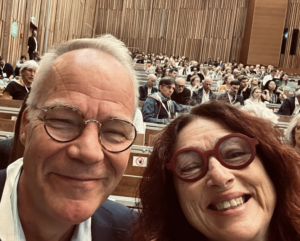
It had been a while since I last saw Matthias Miersch, SPD parliamentary group leader in the Bundestag.
I myself can take credit for the fact that, as Minister of the Environment in Lower Saxony, I initiated a decree on environmental guidelines in public procurement as early as 1992, which—coordinated with other ministries—came into effect at that time. At that time, it wasn’t explicitly about circular procurement, but rather, first and foremost, about ensuring that all of the state’s contracting offices gave consideration to environmental protection, energy conservation, and the materials they purchased. Even back then, we established that the most economical bid does not necessarily have to be the cheapest. We referred to the Blue Angel quality label, we mandated that construction waste must be collected separately, and we emphasized that the public sector must recognize and fulfill its role as a role model.
Today, this is much easier than it was 30 years ago, because materials and product research has improved significantly. Political regulations—such as those governing the approval of hazardous substances—have also become stricter. And there are plenty of ways to procure products that can remain within material cycles. Procurement regulations allow for this; now, all that remains is for the staff at the contracting offices to incorporate the key requirements into their requests for proposals.
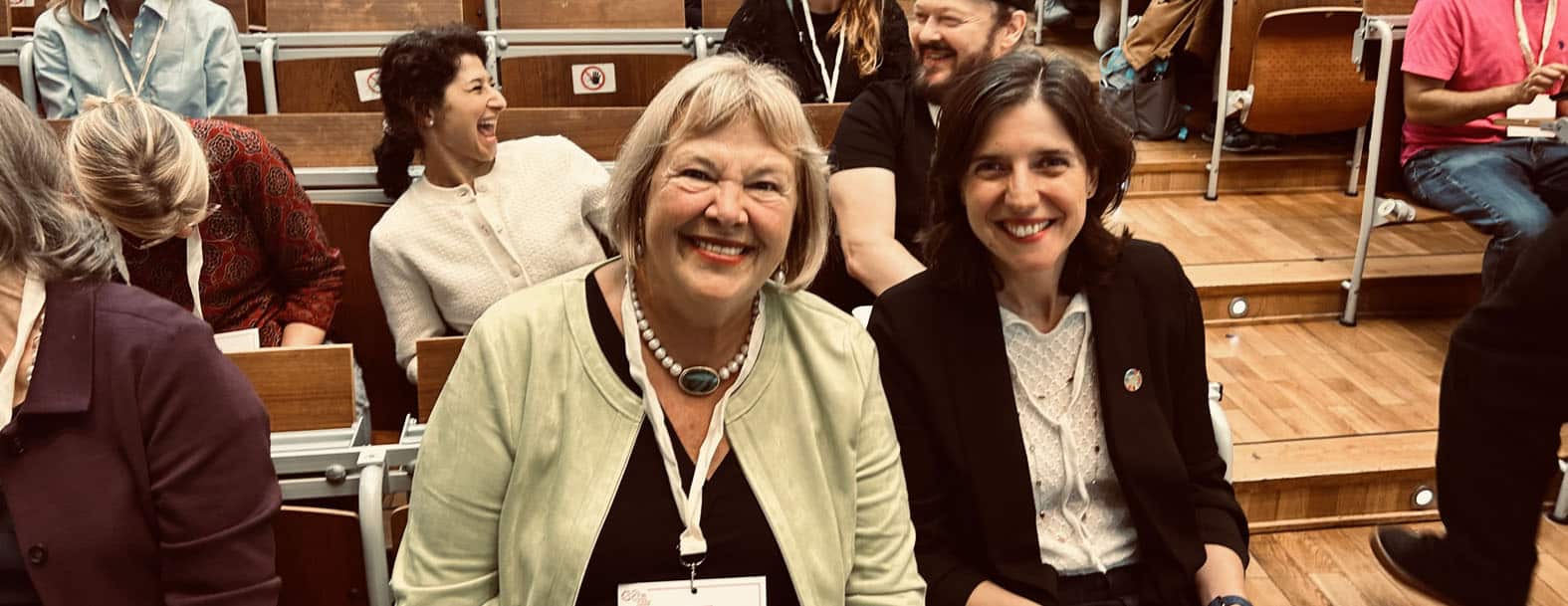
Bettina Hagedorn (left), Parliamentary State Secretary at the Federal Ministry for the Environment, served as patron of the 10th Cradle to Cradle Congress and is seated next to Fatma Deniz, President of the Technical University of Berlin.
Links, all in German:
National Circular Economy Strategy
 Monika Griefahn GmbH
Leave a Reply